
What Is the First Step in How to Start Writing a Book From Your Client Frameworks?
What Happens When You've Taught the Same Framework a Hundred Times but Never Written It Down?
You can walk a room through your six-stage process from memory, adjusting the order to fit whoever's sitting across from you. What you've never done is write it down as one fixed sequence that doesn't need you standing there to make sense of it.
Somewhere in your client sessions, your slide decks, and the diagrams you sketch on whiteboards sits the entire answer to how to start writing a book, except nobody has told you that yet. You built this framework across years of paid engagements, refining it every time a client's situation forced you to explain it a slightly different way. That refinement is exactly why it feels unfinished: a living framework adapts, and adapting things resist becoming a fixed table of contents. Every time you open a blank document intending to write the book version, you hit the same wall, because your framework was built to be spoken, not sequenced. The material was never the problem. The sequence was.
Why Does Codifying a Client Framework Matter More Than Writing Fast?
A framework you've only ever delivered live stays tied to your calendar. The same framework written down, sequenced, and published becomes intellectual property that works whether or not you're in the room.
Most established coaches and consultants already possess the hardest part of a book: a working, tested, results-producing framework. What's missing isn't expertise; it's codifying your thinking into a form that outlives any single delivery. A framework that exists only in your head, your slide deck, or your muscle memory isn't documented anywhere a stranger can access without booking your time. The moment you sequence that framework into chapters, it stops being a service you perform and starts being intellectual property you own outright.
This shift makes a book function as infrastructure rather than a marketing brochure. A signature framework, once it has a fixed structure and a first page, becomes the version of your thinking other people can quote, cite, and hand to someone else - the one document that represents your entire methodology without you needing to reconstruct it client by client. That's the long game a book plays that a keynote or a course module never quite manages on its own.

What Should You Know About How to Start Writing a Book From Client Frameworks?
How to start writing a book from client frameworks means pulling every version of your framework into one place, then choosing a single sequence built for a reader rather than a client mid-session.
Your framework already contains your chapters, they just aren't sequenced yet.
Outlining before drafting prevents the blank page problem entirely.
Client variations of your framework are raw material, not contradictions.
A fixed outline turns a spoken methodology into a reader-ready structure.
Why Does Skipping the Outline Stage Stall So Many Thought Leadership Books?
Most stalled thought leadership manuscripts don't fail because the author lacks material. They fail because the author never sequenced the material before writing began.
Jane Friedman's site published a piece by book coach Stacy Ennis outlining exactly this gap. Ennis argues that before a single chapter gets drafted, a thought leadership author needs to spend real, dedicated time, not a stray afternoon, defining a core message and then outlining the structure and content around it, treating the outline as its own multi-week phase rather than a formality on the way to Chapter One.
That sequencing is precisely the step many experts skip. You already have the anchors, your assessment model, your four pillars, your diagnostic questions, but you go from "I have a framework" straight to "I should be drafting," with no middle stage where those anchors get sorted, tested for order, and matched to a reader's journey instead of a client's session. The result is chapters that start strong and stall, because the framework was arranged for a live audience, not a page.
What Does Jane Friedman's Site Reveal About the Order Outlining Should Follow?
The outline isn't a formality before the real work starts. According to Stacy Ennis's framework, it's the mechanism that decides whether your material creates a profound impact or simply gets read.
The most useful part of Ennis's piece for Jane Friedman isn't the instruction to outline; most writers already know that in theory. It's the specificity of what outlining involves: identifying the core anchors that will organise into chapter topics, then sequencing those anchors deliberately so the material builds toward a profound impact on the reader, rather than simply appearing in the order it occurred to you. Storytelling and the timing of your core message get planned at this stage too, not discovered mid-draft.
Applied to a client framework, your case studies, your exceptions, your sub-steps, and your diagnostic questions are the anchors. None of them is naturally a chapter until you decide where it sits relative to the others. A framework built for live delivery front-loads whatever the client needs that day. A framework built for a book front-loads whatever the reader needs first, and that's a different, deliberate decision.
What Two Moves Turn a Client Framework Into a Working Outline?
Separate your anchors from your delivery, then sequence that structure against a reader's journey instead of a client's session. Those two moves do more structural work than any amount of additional drafting.
The first move is separating your anchors from your delivery. Ennis's framework treats defining the core message, the why, the who, and the what, as work that happens before structure gets touched. For a client framework, that means pulling every version you've ever taught, the one from the boardroom, the one from the podcast, the one you sketch on a napkin, into a single space, then naming the fixed principle underneath all the variations. That principle, not any one delivery of it, becomes your book's core message.
The second move is sequencing for a reader's journey rather than a client's session. Rewritten by You (Chapter 13) makes a related point about blog writing that holds here too: the barrier was never the expertise; it was the absence of a system for organising it before writing began. A framework taught live is ordered around whatever a client needs that day. The same framework in a book needs one fixed order, chosen because it builds understanding step by step for someone who has never sat across from you.
Doing that sorting and sequencing alone, on top of a full client calendar, is where most experts stall out entirely. It's exactly the structural gap a dedicated outlining process is built to close: it takes an existing framework and turns it into a chapter-by-chapter sequence before a single word of the manuscript gets drafted.
How Does a Client Framework Become a Book Outline, Stage by Stage?
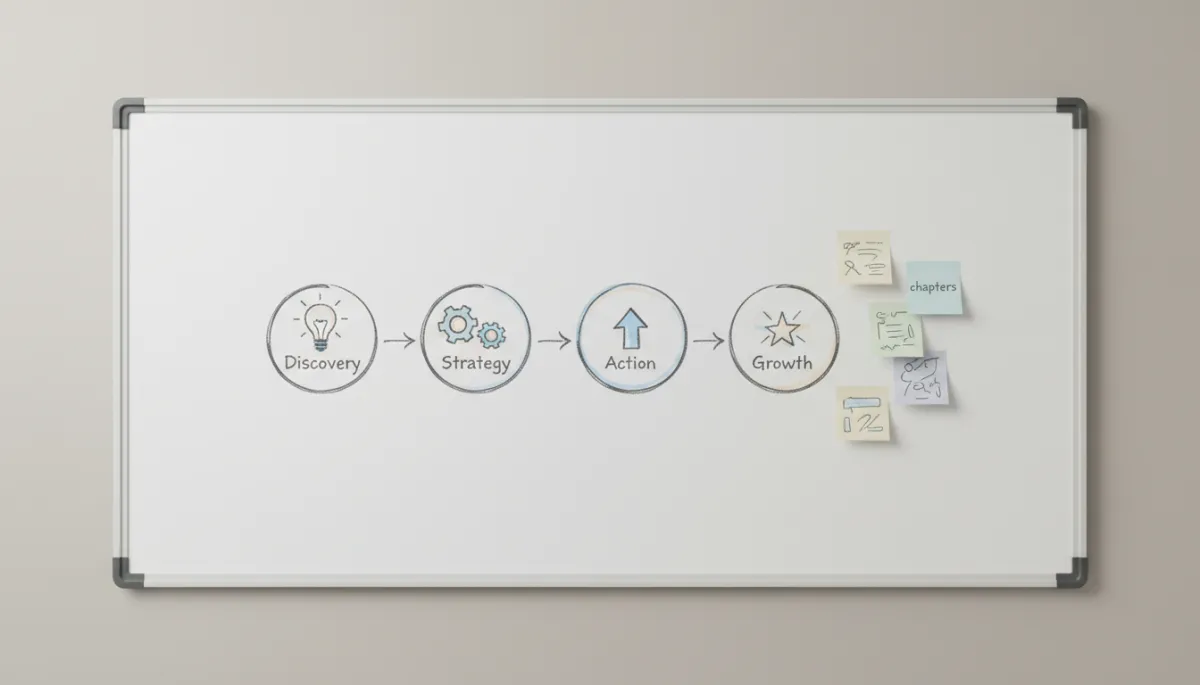
Framework extraction, anchor sequencing, chapter mapping. Three stages, done in order, turn years of client delivery into one document a reader can follow without you in the room.
The Framework Pull. Every version of your methodology, from keynote slides to client worksheets, gets gathered into a single inventory before any sequencing begins.
The Anchor Sort. Each principle, stage, or pillar is tested against a reader's journey and placed in the order that builds understanding, not the order clients happened to need it.
The Chapter Lock. The sorted anchors become a fixed table of contents, the first outline your manuscript will follow from page one to the close.
What Do Experts Ask When Turning a Framework Into an Outline?
These are the questions that come up most once a framework's sequencing work begins in earnest.
Q - Do I need to finish defining my core message before outlining?
Yes. Ennis's framework treats the core message as the north star the entire outline sequence is built around.
Q - Should every client variation of my framework appear in the book?
Not directly. Variations get consolidated into one fixed principle, then sequenced once.
Q - How long should outlining actually take?
Ennis recommends treating it as its own dedicated phase, not something resolved in a single afternoon.
How Does Macro Pro Author Turn a Client Framework Into a Finished Outline?
The anchor sorting you've been putting off for months is exactly the work an AI book coach exists to move through in days.
Macro Pro Author works as an AI book coach that takes the framework you already teach, in whatever scattered form it currently exists across slides, worksheets, and client notes, and sequences it into a working first outline, without asking a busy consultant to build that sequencing system alone. It's built for people who already have the structured expertise and just need it sorted into a reader-friendly format, turning years of client delivery into a manuscript-ready outline at a pace that fits an already full calendar.
What Changes Once Your Framework Has a Fixed Table of Contents?
Once your framework has one sequence instead of a hundred live variations, you stop being the only place people can access your methodology. Colleagues quote you correctly, clients arrive already understanding your model, and the cycle of explaining it again on every call finally ends. You're no longer just the expert who does excellent work quietly, you're the author whose signature framework other people can point to and hand to someone else who needs it. That shift, from a valuable framework only you can deliver to a documented methodology anyone can read, is the shift Macro Pro Author exists to carry through to a finished book.
